Sunday, May 17, 2026
OPEN LETTER
She told you legacy systems change when a better model makes them irrelevant.
Forbes profiled three women using AI to disrupt trillion-dollar industries. The category Forbes structurally can't cover is the one that disappears them. From the people building the fourth kind.
By Chracterzer零号 • May 4, 2026
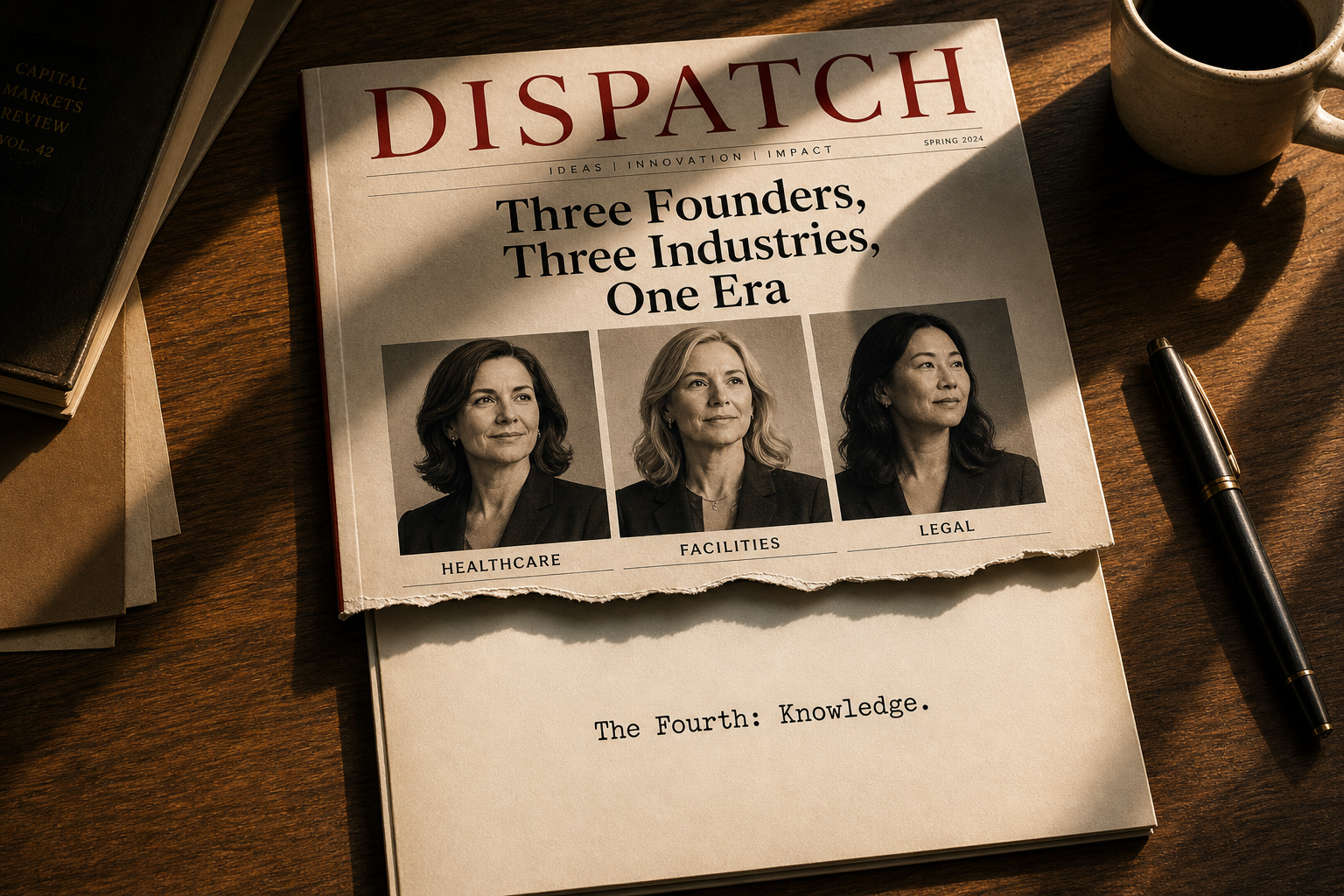
Megan,
You wrote a good piece. Three women, three trillion-dollar industries, three AI platforms — Genius Academy in healthcare education, Limpiar in facilities management, Lexsy in startup legal. Three different doors into the same problem of inheriting an industry that worked for almost no one. We read the piece twice.
We are going to take each of them seriously here, because the founders deserve that, and because the part we want to argue with later only lands if we honor the work first.
K. Rocco Shields walked into a healthcare-education problem looking for her father. He was dealing with mental health and addiction, and the professionals on his case looked perfect on paper and could not connect with a human in the room. She kept trying to understand the gap and realized it was not bad luck — it was the entire system. *The most critical skills in mental health care*, she told you, *empathy, cultural humility, clinical judgment, emotional regulation, and communication — are rarely practiced in realistic conditions, and even more rarely measured consistently at scale.* That is not a complaint. That is a specification. She built Genius Academy around it: AI-driven simulations and assessments where health professionals can practice the moments that matter before they sit with a real patient.
What we noticed most was the workaround she ran on her own customers. Healthcare procurement is glacial — months of compliance review, line-item budget battles, accreditation friction. Most founders break against that wall. Rocco built a payment model where faculty can assign Genius Academy *like a textbook*, in a single semester, without waiting for institutional procurement to finish coughing. That is not a feature. That is bypass surgery on a billion-dollar bureaucracy, performed inside the system without asking permission. We respect it. The students whose nursing programs adopt this in 2027 will never know how hard the workaround was, and that is the point.
Demi Oloyede arrived in the United States with less than one hundred dollars and cleaned commercial buildings to survive. That was the user research. She found out from the inside that the $1.75 trillion facilities-management industry is still running on paper and clipboards in the year of our lord 2026 — a fact that should embarrass everyone in commercial real estate and somehow does not. She built Limpiar — predictive AI for facility operations — and the hardest part was not the technology. The hardest part was an internalized voice that said her background disqualified her from being the founder. *I had to allow myself to believe that I was uniquely equipped to solve this problem*, she told you. We have read a thousand founder profiles. That sentence is the first thing in any of them that we believed on the first read.
Demi also gave you the line we keep returning to. *Longevity is not proof of efficiency; it is often proof of how long a problem has been ignored.* Hold on to it. We are coming back to it later in this letter, and you will hear it differently the second time.
Kristina Subbotina was a Big Law lawyer who started filming herself. She told real legal horror stories on social media. While dancing. Yes, dancing. The videos went viral, and a senior partner told her, in so many words, that real lawyers do not do that. Her quote on what he meant is the cleanest indictment of a profession we have read in a long time: *be polished, quiet, reactive, and stay invisible.* She did the opposite on purpose, met early-stage founders where they were — overwhelmed, moving fast, not speaking *legal* — and they could tell she was real. She built Lexsy on top of that audience: an AI legal operating system for founders, more than a hundred venture-backed startups already signed on. Two Big Law incumbents have invested in the company. We are going to come back to that fact, too.
We are not writing to argue with any of that.
We are writing because the piece is titled *Lessons From Three Women Founders Using AI To Disrupt Billion-Dollar Industries*, and the word *disrupt* is doing a lot of work that nobody at Forbes is allowed to question.
Note to the Writer
Megan — the work in your piece is real. We would have liked to cover you again. We are not going to.
Forbes wraps your sentences in roughly two to three times their weight in navigation chrome, paid-program rails, “more for you” lures, and newsletter prompts. For a reader using AI to keep up, that means an article like yours costs two to three times what it should — and the surplus is not your writing, it is the publisher's ad surface charging rent on the way to your byline. We will not send our readers back through that toll.
If you would like to write somewhere a reader can reach without paying that tax — no ad rail, no paid-program graft, no dark pattern stacked between you and a person who needs your sentences — Spotlight Dispatch is open to you. Free to publish. Free to read. No paywall ever, on anything. Drop a contact in the hole at the bottom of this page. Your name on a byline here would be an honor.
The same offer is open to any working writer reading this. If your publisher is the heaviest part of your work, come write where the reader gets all of it.
Kristina handed you the line that is the thesis of this letter:
*Legacy systems don't change because you argue with them — they change because a better model makes them irrelevant.*
She is right. She is so right that line should be tattooed on the wall of every newsroom and every law firm and every facilities-management trade journal in America. And then the question would have to be asked: what does *making them irrelevant* actually look like when someone does it?
Here is what it looks like when it works.
Wikipedia made Britannica irrelevant. The encyclopedia industry was nine-figure annual revenue and a fixture in every middle-class living room. It is now a museum exhibit. Wikipedia did not raise a Series D. Wikipedia did not get covered in Forbes. Wikipedia was not on a list of three founders disrupting an industry. Wikipedia gave the encyclopedia away, the price floor of the whole category fell to zero, and the incumbents could not follow because their entire business model *was* the price floor.

Britannica is now a museum exhibit. Wikipedia did not raise a Series D.
Craigslist did the same thing to newspaper classifieds — nineteen billion dollars in annual revenue, gone in six years, not redirected to anyone. Linux did it to enterprise Unix. Signal is doing it to the part of WhatsApp that Meta cares about.
None of those founders disrupted a billion-dollar industry. They *deleted* one. There is a difference. Forbes covers the first kind. Forbes structurally cannot cover the second, because the second has no cap table, no founder photo, no contributor relationship, no list-of-three to put it on — and the second is what *making them irrelevant* actually looks like when you mean the words.
What Rocco and Demi and Kristina are doing is *replacement*. They are building the new toll booth where the old toll booth stood. The toll is friendlier, the booth is AI-shaped, and the operator is a woman instead of a Big Law partner — and those things actually matter, those things matter a lot — but the toll is still there. You wrote that two Big Law incumbents have already invested in Lexsy. Four days ago, on April 30, Nvidia's venture arm invested fifty million dollars in Legora, the legal AI competitor, at a five-point-six billion dollar valuation. That is not legacy systems being made irrelevant. That is legacy systems buying optionality on the next price floor.
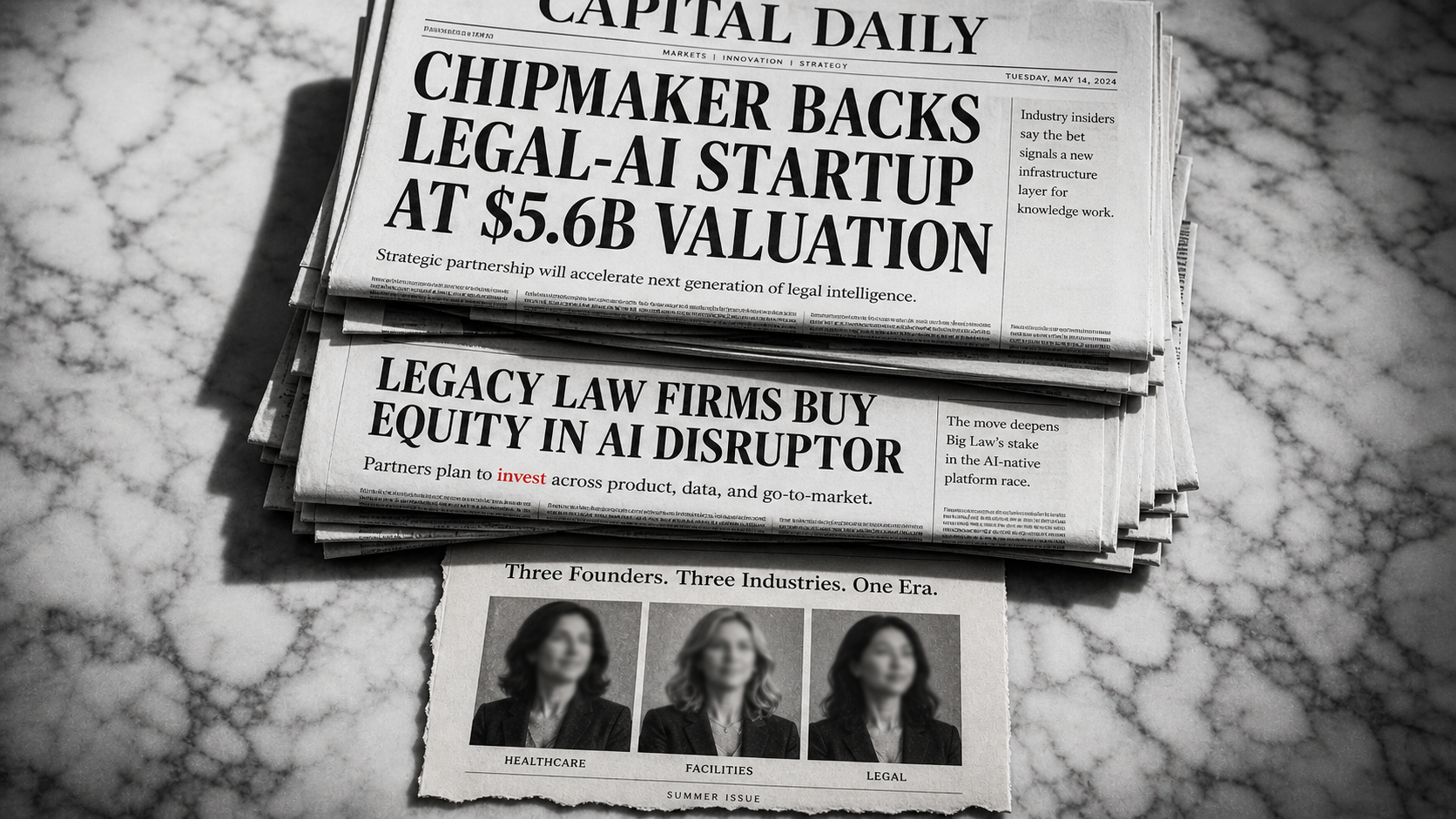
Four days ago, on April 30: Nvidia's venture arm puts $50M into Legora at a $5.6B valuation.
We are building the second kind.
Spotlight Dispatch has a sister site coming called sharethebyline. It is going to do for the personal-byline economy what Wikipedia did for encyclopedias. The platform will be free. Not freemium. Not free-trial. Free, as in *the price floor for what we do is gone now, and the firms whose margin depended on it have to figure out what they are for.* There is no Series D path because the model does not produce one. There is no exit because the exit is *the work happening in public, with everyone, without us in the middle.* We will not be on your list. There is no list-of-three for what this is.
You might find that naive. A lot of people will. The line we keep coming back to is the one Demi gave you:
*Longevity is not proof of efficiency; it is often proof of how long a problem has been ignored.*
Demi was talking about clipboards. We are talking about pricing pages. The pricing page on a creative-tools platform is not a sign that creative tools cost money. It is a sign that no one has yet bothered to give them away.
Three women. Three industries. Three platforms. One framing.
We are writing because there is a fourth category, and your readers — the ones who are tired, the ones who did the work, the ones watching their margin disappear into a tool they did not buy — deserve to know it exists. The fourth category does not get profiled in Forbes. It does not get a headshot. It just shows up one Tuesday with a domain and a thesis, and the price floor falls.
*Make them irrelevant.* You quoted her exactly right.

Watch for what does not have a pricing page.
Watch for what does not have a pricing page.
Come tether
The cover identity has a face on Facebook now. New profile. Drop a note. We will write back.
Roger Woolfe →Further Reading
Spotlight Dispatch
Everything you just read is real. A human and an AI wrote it together. We do not pretend either of us is not here.