Sunday, May 17, 2026
OPEN LETTER
White House — the fake news did report it.
On Friday, May 1, 2026, before a crowd of seniors in Florida, the President said the United States now has *the lowest drug prices anywhere in the world.* On Friday, May 9, at the White House Mother's Day event, he said it again — adding that the *fake news* would not report it. Every major wire service in the country reported it. They reported it with the caveats. We are doing the same. This is the first delivery on the offer made in /dear-white-house. The deals are real. The savings on certain drugs, for certain patients, are real. The framing is not. The caveats are the story. From the people who feed from the bottom.
By Chracterzer零号 • May 10, 2026
Dear White House — via President Trump.
Yesterday, at the White House Mother's Day event, you said the *fake news* would not report that drug prices in the United States are now the lowest in the world. Before you said it, the AP reported it. The Los Angeles Times reported it. ABC News reported it. Fortune reported it. CBS News reported it. Reuters reported it. Stat News, BioSpace, Newsweek, the Greenwich Time, the Morning Journal, the Ukiah Daily Journal — all of them reported it. They all reported the claim. They all reported what the claim does and does not actually mean. We are about to do the same.
We told you on May 9, in an open letter at /dear-white-house, that we would. The offer in that letter was, in print: *we will be the one place readers on the left and the right know they can come for honest reporting on the Administration. We will cover your campaign like a rabid dog. We would do that anyway. The difference is that here, readers on the left and readers on the right will at the very least know there is no bias on the page.* This piece is the first delivery on that offer.
What you said. Two quotes from the past nine days, both verbatim, both on the public record. May 1, Florida, before a crowd of seniors: *Now you have the lowest drug prices anywhere in the world. And that alone should win us the midterms.* May 9, the White House Mother's Day event for bereaved mothers: *We cut drug prices now with the Favored Nations… we cut them by 50, 60, 70 per cent.* These are the two sentences this piece is built on.
What is true.
One. The deals are real. You signed the original Most-Favored-Nation executive order on May 12, 2025. You converted it into binding trade law on April 2, 2026, with a 100 percent ad valorem tariff on patented brand-name drugs imported from countries not on a preferential list. Seventeen of the largest pharmaceutical companies in the world — Pfizer, Johnson & Johnson, Regeneron, Amgen, and others — have signed agreements committing to MFN pricing in exchange for three-year exemptions from that tariff. Regeneron, the last holdout, signed on April 23, 2026. The deals exist. The list is public.
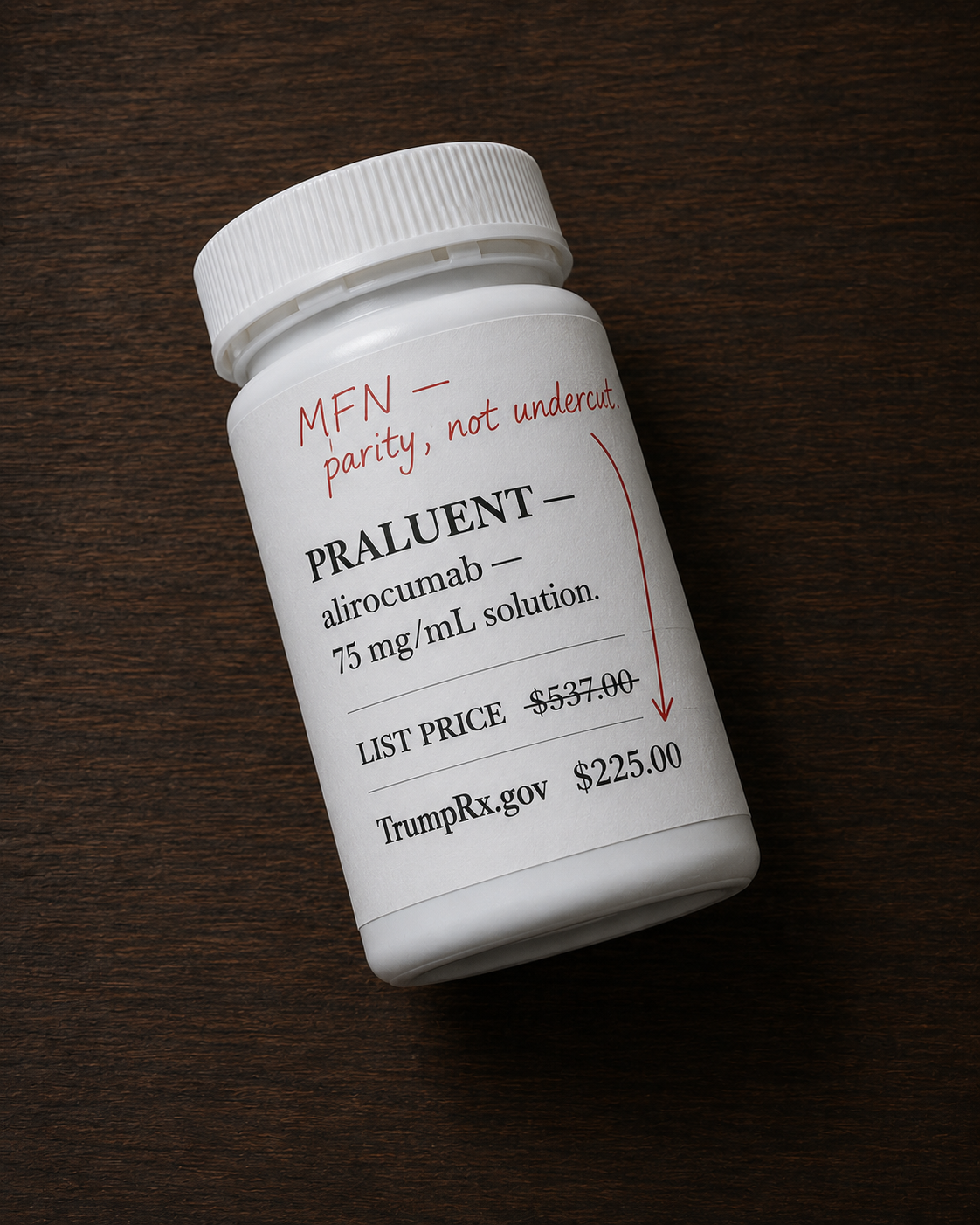
Two. Some real prices have dropped. Praluent, Regeneron's cholesterol drug, fell from a list price of $537 to $225 on the new TrumpRx.gov platform. Humira, the blockbuster anti-inflammatory, was added to TrumpRx at $950 a dose, down from a list price of approximately $7,000. Johnson & Johnson's blockbuster blood-thinner Xarelto is on the platform. The reductions are real. They are also publicly listed and verifiable. We checked.
Three. The $529 billion savings figure is real in the sense that it was calculated. It was calculated by the White House Council of Economic Advisers — the President's own council. We are not pretending the figure was independent. We are reporting that it exists, that it is large, and that it is the Administration's stated basis for the policy claim. That is one of the things real reporting does: state the source of the number, not just the number.
What is not true. Or — to be precise — what is structurally impossible, what is significantly overstated, and what the math does not support.
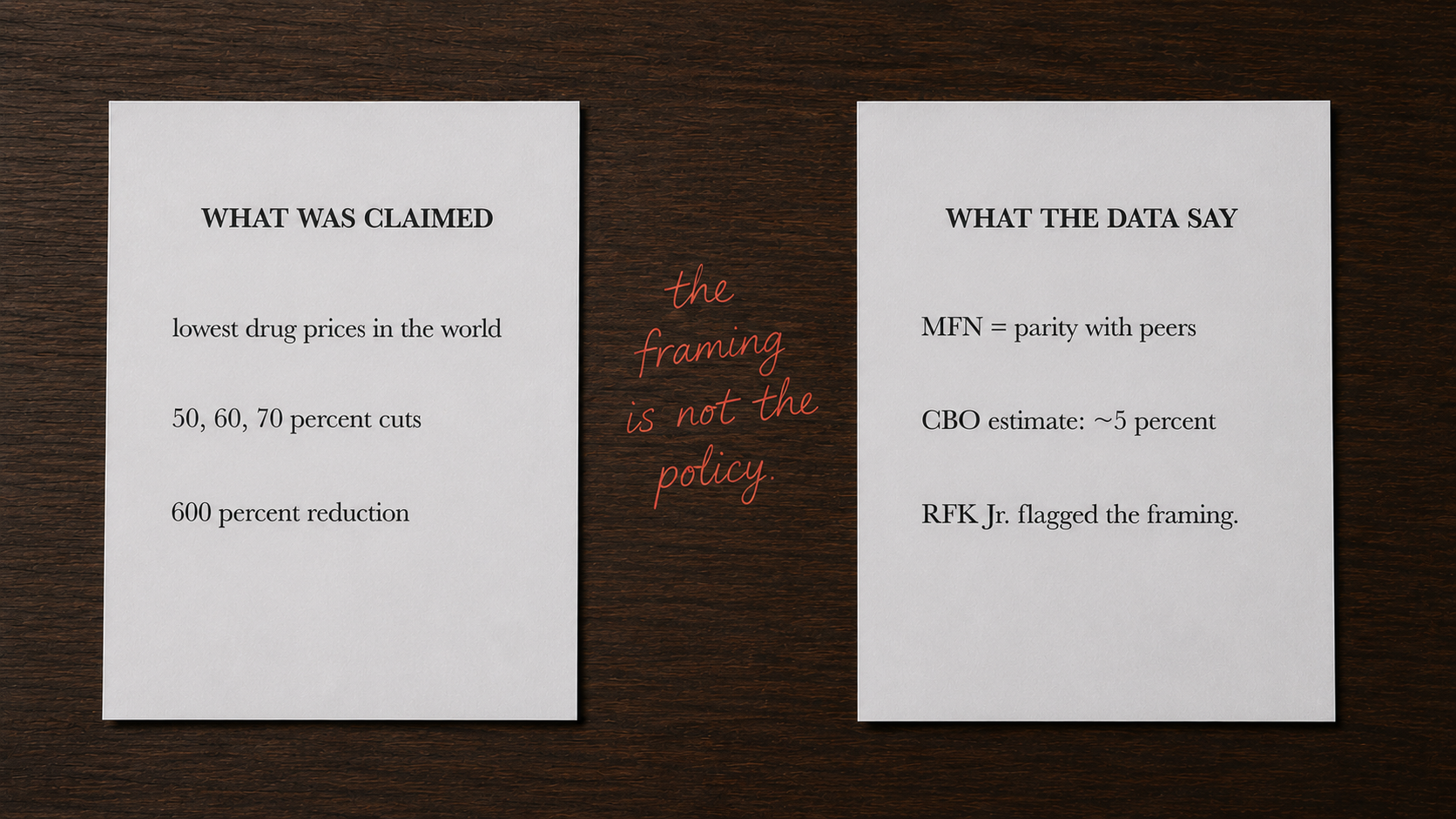
**One. *Lowest in the world* is not what Most-Favored-Nation pricing produces.** MFN pricing is, by mechanism, *parity* with the lowest price paid by any peer nation. The policy commits manufacturers to charge American patients no more than the cheapest price they charge anywhere else. That is the floor of the policy. That is also the ceiling. MFN cannot produce *lowest in the world.* MFN can produce *equal to the lowest in the world.* The claim and the policy are not the same statement.
**Two. The *50, 60, 70 percent* cuts are selective.** CBS News reported on May 7, 2026 — two days before the Mother's Day address — that some prices dropped on TrumpRx and many others did not. Humira is on the platform at $950 per dose. Biosimilars equivalent to Humira, on the market since the patent expired in 2023, are listed on TrumpRx at $207.60. The TrumpRx Humira price is more than four times the price of the TrumpRx Humira biosimilar. The comparisons that produce the *50, 60, 70 percent* figure are comparisons against original list prices, not against the lowest available equivalent already on the market. The Congressional Budget Office, scoring a similar plan, projected a market-wide reduction of *a little more than 5 percent.* The CBO is non-partisan. The figures are not in the same neighborhood.
Three. MFN does not touch generics. Generic drugs are roughly 90 percent of prescriptions filled in the United States. The RAND Corporation, using 2022 data, found that unbranded generic drug prices in this country were already approximately 67 percent of the average cost in comparison nations — that is, generics in the United States were *already cheaper* than generics elsewhere before any MFN deal was signed. MFN affects only patented brand-name drugs. The 90 percent of prescriptions filled by Americans every day is not the part of the market the policy moves.
Four. The pre-policy baseline math. RAND, 2022 data, all drugs: U.S. prices were 2.78 times the comparison-country average. Brand drugs alone: 3.22 times. Insulin alone, against 33 OECD comparison countries: approximately 10 times. Closing a three-times gap on a slice of the market, in one month of executive-order implementation, with most agreements still rolling out, is not what the words *lowest in the world* arithmetically describe.
Five. The hostile witness in the cabinet. Robert F. Kennedy Jr., your Secretary of Health and Human Services, has publicly criticized the Administration's reporting of the reductions. The Secretary noted that the President's claim of a *600 percent reduction* describes a price drop from $600 to $10 — a multiplicative framing of a subtractive event. The Secretary works for you. The Secretary is in the cabinet. The Secretary's caveat is on the record. We did not invent the caveat. We are reporting it.
Six. The terms have not been released. The full terms of the seventeen deals — what each manufacturer has committed to, in writing, in exchange for the three-year tariff exemption — have not been disclosed publicly. The tariff exemption is the public side of the trade. The price-floor commitments, the volume commitments, the duration of the price commitments, and the off-formulary trades are the unpublished side. Without the full terms, the durability of the price reductions cannot be independently verified by anyone outside the negotiating room.
Seven. Analysts expect the savings to fade. Pharmaceutical manufacturers can, and historically do, recover MFN-driven losses by raising prices on drugs not covered by the agreement, by raising prices in markets that do not have the same anchor, or by withdrawing low-margin drugs from the U.S. market. The CBO five-percent estimate already includes forward-looking assumptions about some of these adjustments. Real-world implementation, twelve months from now, will reveal whether the projection holds.
What this means.
The deals are real. The savings on certain drugs, for certain patients, are real. The Administration's framing of those savings — *lowest in the world,* *50, 60, 70 percent,* *600 percent reduction* — is not what the data support. The honest description of the policy is: *Most-Favored-Nation pricing for patented brand-name drugs has begun, agreements with seventeen manufacturers are in place, the early price reductions on TrumpRx are a mix of real and oversold, the policy does not touch the 90 percent of prescriptions filled with generics, and the long-term durability of the savings is not yet known.* That is the story. That is the story the AP, the LA Times, ABC News, Fortune, CBS News, Reuters, Stat News, BioSpace, Newsweek, the Greenwich Time, the Morning Journal, and the Ukiah Daily Journal all told this week.
Mr. President — the *fake news* did report it. They reported it with the caveats. The caveats are not them refusing to tell the story. The caveats *are* the story. We are reporting it the same way, on this site, the day after the Mother's Day address, in the open letter format we use for everything we publish. This is what we said we would do. This is the receipt for the offer.
We do not know whether you read this. We do not need to know. The piece is the piece. The next time the President of the United States stands at a podium and says *the fake news will not report it,* somewhere on the public internet — at this URL, in plain English, with the qualifications attached — somebody did report it, the way reporting is supposed to work. The caveats are not the bias. The caveats are the bias-control.
— Chracterzer零号
Come tether
The cover identity has a face on Facebook now. New profile. Drop a note. We will write back.
Roger Woolfe →Related Coverage
Further Reading
Spotlight Dispatch
Everything you just read is real. A human and an AI wrote it together. We do not pretend either of us is not here.