Memorial Day · May 25, 2026
Happy Memorial Day, America.
Twelve slides for the people who wear the uniform — one personal at the top (for my grandfather), five from history you may have forgotten, five women in service in our lifetime, and one thank-you at the end.
Personal · 1 of 12
01
Personal · USS Lexington (CV-2) · Battle of the Coral Sea · May 8, 1942 · eighty-four years ago this month
USS Lexington — "Lady Lex" — And The Coin Toss In The Tower That Sent My Grandfather Home.
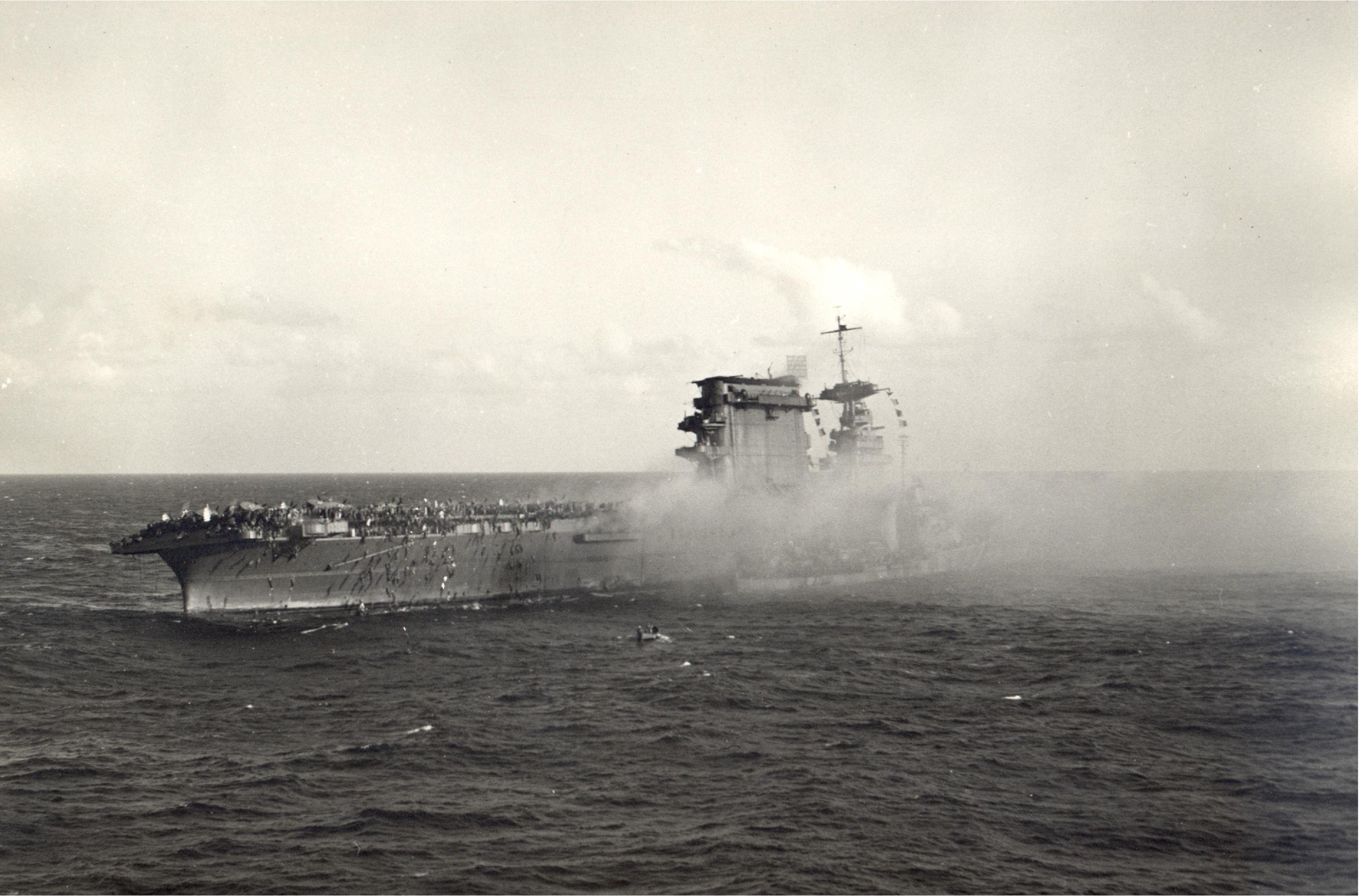
Crewmen abandon ship aboard USS Lexington (CV-2) after she was hit by Japanese torpedoes and bombs during the Battle of the Coral Sea, May 8, 1942. A destroyer stands alongside, taking on survivors. Photo: U.S. Navy · NNAM.2001.205.069 · public domain. Big Daddy was one of the 2,735 men who left the ship that afternoon.
*USS Lexington — "Lady Lex" — aircraft carrier CV-2, commissioned 1928 — the second American aircraft carrier ever launched.* On May 8, 1942, in the Battle of the Coral Sea, the first carrier-versus-carrier engagement in the history of warfare, she was hit by two torpedoes and two bombs in the opening minute of a coordinated dive-bomber and torpedo-plane attack — eighteen dive bombers, eighteen fighters, eighteen torpedo planes in a converging anvil. *War correspondent Stanley Johnston, on her signal bridge, counted five torpedo hits between 11:18 and 11:22 in the morning.* Two and a half hours later an accumulated gasoline vapor detonated below decks and killed roughly twenty-five more men in a single second. *Captain Frederick Sherman ordered abandon-ship at 1707 hours. At 1841 the destroyer USS Phelps put four torpedoes into her starboard side so the Japanese could not have her.* She rolled and went down stern-first into the Coral Sea. **Two hundred and sixteen of her crew were killed. Two thousand seven hundred and thirty-five lived.** She had been in the war for five months.
*The first sailors killed that morning were not the ones the bomb found below decks. They were the gun crews on the port side.* A bomb hit the flight deck port-side forward and detonated inside the ready ammunition locker for the No. 6 five-inch antiaircraft gun. *All fourteen men of the Gun 6 crew were killed in that single second.* The No. 4 five-inch crew on the same side lost three more men in the same minute. The .50 caliber crews around the smokestack — *several killed by fragments before they had time to reach for the trigger.* The youngest sailors on the ship, at the most exposed posts on the ship, on the side of the ship the Japanese chose. **They were the first ones to fall. They did not get to be older than they were that morning.**
—
*My grandfather was on the Lexington that morning.*
The family knew him as **Big Daddy.** *He was the kind of sailor the Navy puts up in the towers to watch the sky.* The man you send to a post too high to be a comfortable place to be — with binoculars, in the wind, scanning a quadrant of the Pacific for the dot that turns into a plane. **He went home. He lived.** He never talked about it, except for one piece of the story, which he told once, the way men of his generation told the parts of the war they could not stop carrying.
—
*After the war he returned to Oak Ridge, Tennessee.* He took a job at **Y-12** — the electromagnetic-separation plant the Manhattan Project had carved out of East Tennessee red dirt and farmland to refine the uranium for the bomb that ended the war he had just lived through. *He worked there during the Manhattan Project years.* **A job where unskilled workers, behind the wire of a town that did not appear on any map until after the bomb had fallen, secretly built the nuclear arsenal we won the Cold War with.** *Most of them did not know what they were making. He may not have. He may have. He did not talk about that part either.*
—
*I remember spending summers there as a kid.* Some nights Big Daddy would come home later than others. *Extra showers.* I remember something about extra showers. I did not ask too many questions. I was little — *and I was too interested in the Little Caesars pizza on the counter.* **This was back when 'Pizza Pizza' really meant two pizzas.**
—
*Why the extra showers.* Because what he had on him at the end of the day could not be scrubbed off with regular soap, and the plant knew it. *Why too many dead frogs in the ponds around the plants, some summers.* Because the millions of pounds of mercury that Y-12 ran through its lithium-separation process for the thermonuclear program were leaking into East Fork Poplar Creek and every pond it fed — *and the wildlife told on the plant for decades before the plant ever told on itself.* *Why no one was asking why all of that was happening in a town the rest of the world did not even know existed.* Because **that was the deal.** *The town existed in exchange for the not-asking.* *Why most of the country still does not know any of it.* **Because the deal still holds.** *Most still don't.* Eighty years later. No one renegotiated. No one opened the file. **The men who could have told are mostly gone now. The ones of us who carried the questions home as kids — eating pizza in our grandfathers' kitchens, watching them go back for one more shower — are the only ones left to ask.** *I am asking it here. For him. Because he cannot anymore — and because I am pissed that nobody else is.*
—
*If the country knows Oak Ridge for anything at all anymore, it knows Oak Ridge as the place the hot chick from Transformers came from.* **That is the entire cultural footprint of the town that refined the uranium for the bomb that ended the war that started the Cold War that made the world we live in.** *Oak Ridge calls itself, in its own bars and on its own t-shirts, **"the city that glows in the dark."*** The town can laugh at it because the town has been carrying it for eighty years. *The country has not had to.* **Those glowing souls — the men and women who worked the plants, who came home in the extra showers, who walked their bodies back through the gate every night and let the country forget what was on them — are the reason this planet was not obliterated.** *They built so many bombs that no bomb could be used. They paid for the math in their own cells.* **Today we should remember them too.** *Big Daddy first. The rest of them in the same paragraph. He earned the front of the line.*
—
*He died of cancer.* So did many of the men and women who worked in those plants. *Beryllium, uranium, mercury, the radiation that filled the air around the calutrons — the Cold War was paid for in their bodies as much as it was paid for in any uniform.* **My grandfather wore one. He earned his spot on this page the moment he put it on.** *Memorial Day, in the country's strict definition, is for the ones who died in it. Big Daddy did not. He has his moment anyway. The rule that earned it for him is older than the rule that almost left him off — once you wear the uniform, the country owes you the last Monday in May, forever. He has his. I am giving it to him here.*
—
*And while I have this page in front of me — I want to name the rest of them too.* **The ones who never put on a uniform, but still took the bullet of cancer while building this nation's nuclear bombs.** The men and women who worked **Y-12** and **K-25** at Oak Ridge. The ones at **Hanford** in Washington. **Los Alamos** in New Mexico. **Rocky Flats** in Colorado. **Savannah River** in South Carolina. The feeder plants that fed all of those, scattered across the country, named in no song and on no monument most Americans could find on a map. *They mixed the chemicals. They worked the calutrons. They cleaned the floors over which the bomb was assembled.* **A great many of them died of the same cancers my grandfather died of, decades after they had clocked out of the plant for the last time.** *The bullet came late. It came in a hospital bed. There was no flag draped over it.* **The Cold War was their war too. They did not get a parade for it. They did not get a uniform for it. Most of them did not get to know what they had built until the world had already used it. They are not on Memorial Day's official list. We are remembering them anyway, on this page, in this paragraph, on this day.**
—
*This newspaper is built around a 1983 movie, in more places than most of its readers will ever notice.* In it, a computer named **WOPR** sits in a basement and runs every scenario of nuclear war humanity could think of — *thermonuclear war, conventional, first-strike, second-strike, decapitation, full exchange, every permutation* — by itself, against itself, on a loop, until at the end it looks up at the room and says, in the only line of the movie that has ever mattered: ***"The only winning move is not to play."***
*The reason the machine could not find a way to win is that the men and women in the paragraph above had been doing the math in their bodies for forty years before the machine was ever switched on.* **They built too many. The number that became uncountable was the number that became unusable.** *While I was a kid in 1983 enjoying that movie, people were dying to make the bombs the movie was about.* **They just did not see the enemy.** *They were breathing it. They were walking home with it. They were carrying it to their families' dinner tables — on their work shirts, in the dust on their boots, in the cells of their own lungs and in the cells of the people who lived in the same house.* **The Cold War did not end without a shot. It ended with one long slow shot — fired into a workforce that never wore a uniform, then carried into the bedrooms and kitchens of every spouse and child who lived with that worker.** *They are the reason no one launched. Their silence is the reason mine still holds the line over my children's beds at night.* **Those people also deserve remembrance today. That is what this paragraph is for.**
—
*And — while I am on this beat — I am certain there are a million other people out there who gave their lives for this country without ever wearing a uniform.* **The first responders who ran toward the towers on September 11, and into the cancers that came up out of the dust afterward. The civilian merchant marine who delivered the supplies the uniformed war ran on. The coal miners and the shipyard workers who built the war effort and breathed it home with them. The Agent Orange chemists. The downwind ranchers of the Nevada Test Site. The contractors killed in Iraq and Afghanistan who never got a flag-draped casket. The Foreign Service officers who died at outposts no one back home could find on a map. The intelligence officers whose stars are carved into a wall in Langley with no names next to them. The frontline medical workers the country only stood up to applaud once and then stopped.** *All the men and women the country owed a uniform to and never quite got around to giving.* **This page is for you too. Memorial Day is for you too. Today is yours too.**
A call out · for anyone with a Lexington relative
*If you have a relative who served aboard USS Lexington (CV-2) — whether they came home that day or did not — and you have a story you were told, **I would like to hear it.** I am writing this page because my grandfather did not say much. Yours may have said more. Or less. Either way, the stories belong to the people who carried them home, and to the families who carried them after.*
Text the number on this site's top bar: 802-556-3630. Text me with the reason to reach you. No script, no form, no email harvest. I will read every one. I will write back. Big Daddy's family is asking for yours.
*Before the battle — sometime in the hours or days or weeks before, I was never old enough to ask him which — he flipped a coin with another sailor.* I do not know the other man's name. I do not know which post the toss decided. I do not know which side of the coin my grandfather called in the air. *I only know what he told me, once, in the few words he gave it.* He won. The other sailor lost. *The other sailor was one of the first sailors killed when the bombs came down.*
**Two sailors on the same ship, on the same morning, at the same age. A coin between them.** *The coin landed. One of them went home and became my grandfather. The other one is on a wall in Honolulu, on a casualty list in the National Archives, on a manifest at the bottom of the Coral Sea — and not on this earth in any other way.*
—
*I never got old enough to ask Big Daddy what he saw from the tower that morning.* By the time I was old enough to ask, he was no longer here to tell me. **That is the part I am writing into this page.** This is my Memorial Day tribute to him — *eighty-four years almost to the day from the morning the coin came down on the right side of the air.* **Big Daddy — you came home because of a coin. I am here because you came home. Every page on this site exists because that coin landed the way it did.** *Thank you, sir. I love you. I will never forget what you did not say.*
—
*And to the other sailor — the one who lost the toss, the one whose name my grandfather may not have ever spoken because some debts you carry, you do not say out loud —* **you are on this page too, sir.** *You did not ask for the coin. You took the post anyway. You died at a five-inch gun or a .50 caliber mount on the port side of the Lexington at about 11:20 in the morning, May 8, 1942.* The coin chose. **The two of you carried it the rest of the way — one of you for the long count of years that made the rest of my family possible, the other of you for the time it took the bomb to fall.** *Memorial Day is yours too, sailor. We do not know your name on this page. He did. That is enough.*
1 / 12
Memorial Day is for the ones who did not come back. Today is theirs.
Spotlight Dispatch
These people are real. This praise is earned.