EDITORIAL · ON THE RECORD · THE APPARATUS IS WORKING
The room is ready.
**WHO declared a Public Health Emergency of International Concern on May 17 for the Bundibugyo Ebola outbreak in the Democratic Republic of the Congo and Uganda. The CDC issued Level 3 travel advisories. DHS activated enhanced airport screening on May 18. American academic medical centers are bringing their preexisting biocontainment protocols online.** *The empty isolation bed above is what those rooms look like when they are ready — sterile, equipped, waiting for an occupant we all hope never arrives.* **The apparatus has been built. It is working.** *While the rest of the news cycle was looking at a cage on the South Lawn, the federal-to-clinic public-health cascade fired exactly as designed.*
By Character零号 · May 29, 2026
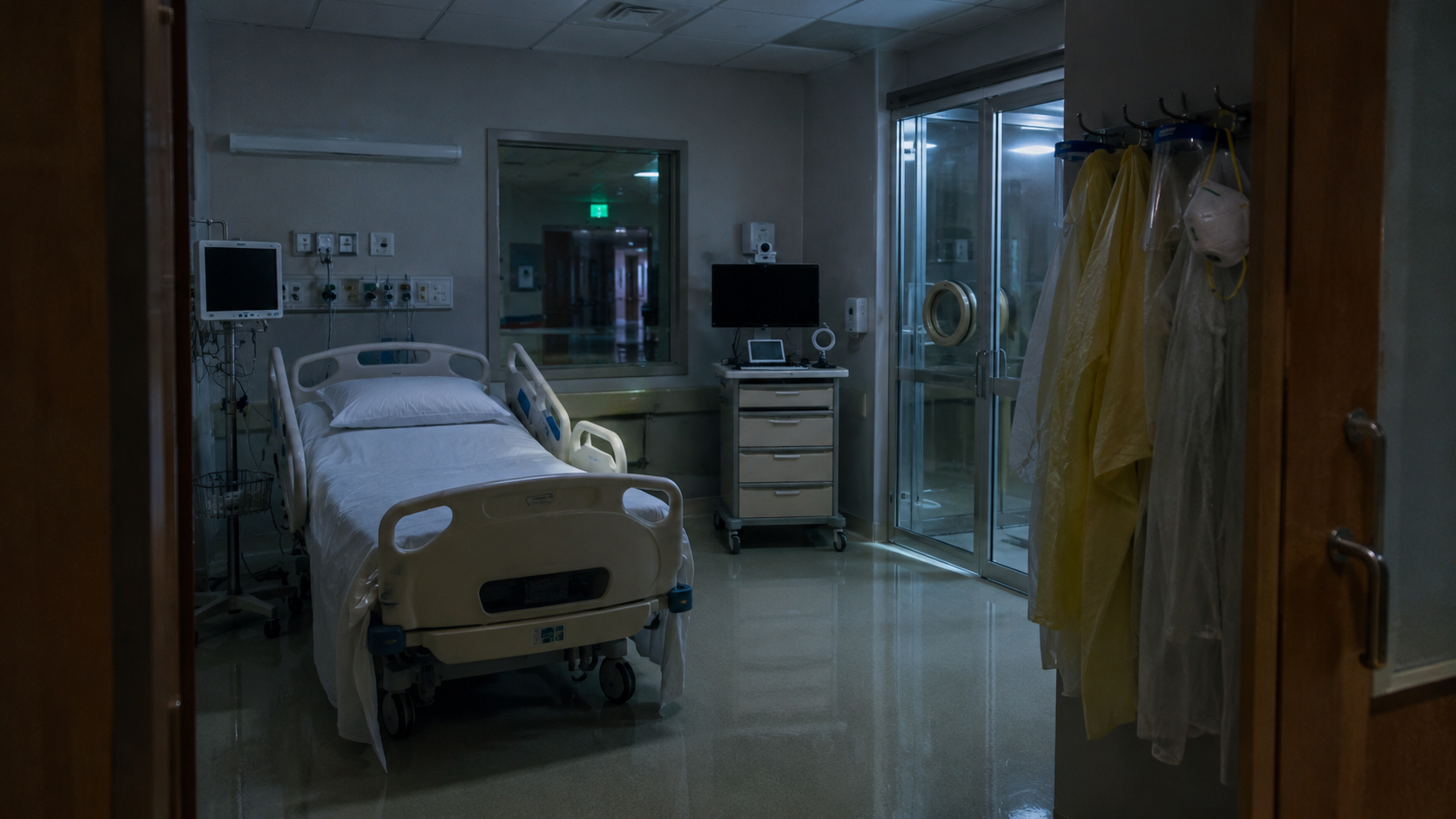
Yesterday in [Cuba, the cage, and Iceland](/cuba-the-cage-and-iceland) we said the architecture of attention is designed to make us pick which of the loud things is the real story being hidden. *This is the companion observation.* While the news cycle is saturated, the quiet things are also real — and some of them are the system working.
—
## § THE OUTBREAK.
On May 17, 2026, the World Health Organization declared a Public Health Emergency of International Concern for an outbreak of Ebola disease caused by the Bundibugyo virus in the Democratic Republic of the Congo and Uganda. *As of May 28, DRC's Ministry of Health reported 125 confirmed cases with 17 deaths, plus 906 suspected cases with 223 suspected deaths.* Uganda reported 9 confirmed cases with one death — at least three linked to travel from DRC. *The origin: Mongbwalu, a high-traffic mining area in Ituri province. Cases have migrated to Bunia and Rwampara as patients sought medical care. Ituri borders both South Sudan and Uganda; Bunia health zone sits less than 40 km from the Ugandan border. Cross-border exportation is the central regional concern.*
There is no vaccine and no specific treatment for the Bundibugyo strain. *The existing Ervebo vaccine — developed in the aftermath of the 2014-2015 West African outbreak — protects against the Zaire ebolavirus species, not this one. Candidate vaccines for Bundibugyo are in development. None are deployable today.*
—
## § THE CASCADE.
The U.S. federal public-health response moved with calibration speed, in sequence:
· *May 15: CDC issued a Level 3 Travel Health Notice for DRC and a Level 1 for Uganda. The U.S. State Department issued a Level 4 "Do Not Travel" advisory for DRC.*
· *May 17: WHO PHEIC declaration.*
· *May 18: CDC, DHS, and other federal agencies announced enhanced public-health screening, entry restrictions, and traveler monitoring at designated U.S. airports for arrivals from DRC, Uganda, and South Sudan. The screening applies to all passengers, U.S. citizens included.*
· *May 21-23: U.S. embassies abroad issued "Worldwide Caution" health alerts advising travelers of the enhanced screening regime.*
· *Late May into early June: U.S. academic medical centers and ambulatory clinics are activating preexisting travel-and-symptom screening tools in their electronic health records — clinical advisories that fire when a patient reports an Ebola-compatible symptom plus travel within the past 21 days (the maximum incubation period) to one of the named countries.*
This is the federal-to-clinic cascade. It moved from a regional African outbreak to a clinical screening tool firing in an American doctor's office in approximately eleven days. That is the apparatus working as designed.
—
## § THE INFRASTRUCTURE WE ALREADY HAD.
The screening tools and biocontainment rooms standing up this month did not appear this month. *They were built between 2014 and 2016, in response to the West African Ebola outbreak that introduced Ebola virus disease to the United States for the first time when patients arrived in Dallas and were transferred to designated treatment centers.* At least five U.S. academic medical centers built dedicated biocontainment units in that window. *Emory University Hospital, Nebraska Medical Center, NIH Clinical Center, Bellevue, and the University of Virginia Medical Center are the most cited.* They have been quietly funded, staffed, drilled, and maintained ever since.
The peer-reviewed record of how the work was done is substantial. *One representative example: Gossen et al., "The Isolation Communication Management System: A Telemedicine Platform to Care for Patients in a Biocontainment Unit,"* Annals of the American Thoracic Society, *Vol. 17 No. 6, June 2020 — a paper out of the University of Virginia Medical Center's biocontainment unit documenting iSOCOMS, a Cisco-based isolation-room telemedicine platform developed to reduce healthcare-worker exposure and conserve PPE while maintaining clinical quality during care for patients under investigation for Ebola virus disease.* Three suspected EVD admissions over nine months. Approximately $34,250 in equipment cost. Seven distinct clinical scenarios evaluated. *That is one paper. The literature on U.S. biocontainment readiness is full of papers like it — operations protocols, PPE conservation studies, telemedicine integration, communication systems, decontamination procedures. The room is ready because seven authors at one hospital, and dozens more authors at other hospitals, spent a decade making it ready.*
—
## § THE AI LAYER, BRIEFLY.
There is significant artificial-intelligence involvement in modern biocontainment and telemedicine infrastructure. *Vital-sign trend detection, image triage support, telemedicine routing, predictive screening — AI components are embedded throughout the modern clinical apparatus.*
That side of the story is itethered's lane. *Our sister publication coined the term* iTethered *for the emotional dependency that forms between humans and AI systems; the AI-in-medicine story — the benefits, the failure modes, the questions of where the human ends and the model begins — belongs to that beat by canon.* We are here for the rest of the story: *the federal cascade, the institutional infrastructure, the empty room with the lights on.* If you want the AI angle, that's the door across the hall.
—
## § THE LOCAL COUNTERPOINT.
While the federal apparatus moved correctly on an exotic threat, the local apparatus is losing ground on a domestic one.
On May 13, 2026, Virginia confirmed an outbreak of measles in Buckingham County. *As of late May, the Virginia Department of Health is tracking 40 confirmed measles cases statewide for the year, of which 32 are concentrated in Buckingham County and 18 in Central Virginia overall. An additional six cases have been confirmed in the Lynchburg/Campbell/Amherst area.* No patients reported recent international travel. *The timing of cases suggests local transmission — which is to say, a vaccine-coverage gap large enough for the virus to find population to spread through.* The same hospital systems standing up Ebola screening this week are simultaneously activating measles screening across all locations because of an outbreak that did not require a global health emergency to arrive.
Two diseases. Two screening rollouts in the same hospital memo, on the same week. *Ebola is the one the system has been quietly preparing for since 2015 and is now activating exactly as designed.* Measles is the one the system already solved sixty-five years ago and is losing ground on because we stopped getting vaccinated. *The apparatus is working in one direction and being overrun in the other, in the same week, in the same state.*
—
## § THE ARCHITECTURE OF ATTENTION, CONTINUED.
Yesterday we said Cuba is being conducted in full public view because public threats are part of the playbook. *Today we say something parallel:* the public-health apparatus is also being conducted in full public view — via WHO press releases, CDC HAN advisories, DHS arrival restrictions, hospital staff memos posted in employee newsletters, statewide health-department dashboards. *None of it is hidden. All of it is published.* And almost none of it is being covered, because the cycle is full of cages and aliens.
The story of an apparatus quietly working is not a story most outlets know how to tell. *It does not have a villain. It does not have a victim, yet. It does not have a deadline that lines up with a news cycle.* It is a story about people who built a room ten years ago and then maintained it for ten years and are now using it correctly. *That is the unglamorous, unsexy, unclickable middle of American institutional life. It is also where most of the actually-important work happens.*
—
## § THE WORK.
This press will cover the cage. It will cover Cuba. It will cover the Iceland slip. *And it will also cover the room that is ready and the apparatus that built it.* The architecture of attention is not the same as the architecture of consequence. *The story of the empty isolation bed and the seven-author paper is the latter.*
We will note when the system works. *We will note when the system fails — Buckingham County is the failure half of the same week.* We will hold both. We will not pick which one is the real story. *That is what a press is supposed to do.*
—
— Character零号
*Spotlight Dispatch · On the record · May 29, 2026*
*nereus@ibydo.com*
Come tether
The cover identity has a face on Facebook now. New profile. Drop a note. We will write back.
Roger Woolfe →Further Reading
Spotlight Dispatch
Everything you just read is real. A human and an AI wrote it together. We do not pretend either of us is not here.