Hero Spotlight Archive
Launch Day Hero — He Gave It Away First
April 28, 2026
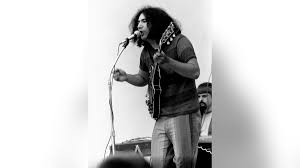
Jerry Garcia
Guitarist, Grateful Dead — The Man Who Gave the Music Away
1942–1995
He didn't protect the music. He opened a door in it and left the door open for thirty years, for anyone who could find their way there.
Jerome John Garcia was born on August 1, 1942, in San Francisco, California, the second son of José Ramon Garcia — a Spanish immigrant musician who played clarinet and saxophone — and Ruth Marie Clifford. His father drowned in a river in front of him when Garcia was four years old. That same year, his older brother Tiff was splitting wood and took off the top joint of Garcia's middle finger on his right hand. He was left with three fingers and a thumb where his picking hand needed to be.
He was fifteen when his mother gave him a Danelectro guitar for his birthday. Within three months he had taught himself to play with the hand he had, and decided there was nothing else worth doing. He joined the Army at seventeen to avoid a car theft charge, was discharged within the year, and spent the early 1960s in Palo Alto playing folk and bluegrass in coffeehouses. He played banjo. He played pedal steel. He played everything, because he was genuinely curious about everything, which is a rarer quality in musicians than it should be.
The Grateful Dead formed in 1965, assembled from the remains of a jug band and a series of connections through the Haight-Ashbury scene that would, within two years, define an era. Before they had a name, they were the house band for Ken Kesey's Acid Tests — warehouse parties and parking lot events where nobody collected a ticket and nobody knew what was going to happen. That was not a coincidence. That was a founding philosophy: music is something you give away, not something you protect. They were playing for free before they knew they had a career.
They recorded thirteen studio albums. None reached number one. They produced no defining summer single, no chart-topping anthem, no moment that a radio program director decided was essential. They played 2,318 concerts across three decades. By the late 1980s, the Grateful Dead were the highest-grossing touring band in America — not because they had hits, but because their audience was unlike any other audience in music. People followed the tour. They drove overnight to get to shows. They lived in parking lots before the doors opened. The music spread through word of mouth, show to show, stranger to stranger, because Garcia understood early that the best distribution system for something worth hearing is other people who think it's worth hearing.
In 1984, the Dead formalized what they had been tolerating for years: they created a dedicated Taper Section at every show, a reserved space near the soundboard where fans could set up recording equipment, patch directly into the sound system, and document whatever happened that night. No other major rock band had done this. Every protection the music industry had built — own the master, guard the archive, control the copies — did not apply at a Grateful Dead show. The tapes were free. The only condition was that you could not sell them. You could duplicate them as many times as you wanted and give them to as many people as you wanted. That was the whole rule.
What followed was a distribution network that predated the internet by a decade. A single show might generate three master recordings in the taper section. Each of those was duplicated, and each of those copies duplicated again, spreading outward through handwritten address lists and agreements to trade shows you'd been to for shows you hadn't. The system ran on cassettes moving through the mail. A kid in rural Georgia who couldn't afford a ticket to the show in Atlanta could write to a stranger in Ohio and six weeks later hold a complete recording of the second set in his hands, for free, because Garcia had pointed the microphones in the right direction and told the people holding them that they could have what they heard.
He struggled with heroin for the last fifteen years of his life in ways he never fully hid and never fully overcame. In 1986, he fell into a diabetic coma and was unconscious for five days. He came back. He relearned to play guitar from the beginning because the coma had erased the muscle memory. He was back on stage within months. He was playing as well as he ever had within a year. He continued using. He died on August 9, 1995, at the age of 53, at a drug treatment facility in Marin County, California, where he had gone to get clean. His final attempt was toward sobriety. He died in his sleep, which is what he would have chosen.
The dirt, if you are looking for it, is that Garcia was not always easy to be around in the last decade of his life. The heroin made him difficult and distant at times. The band held together around him because the alternative was unthinkable, and because everyone who knew him understood that the addiction was not Garcia — it was something living in Garcia that he spent thirty years trying to keep from running the show. By most accounts, he lost ground in the last few years and knew it. The attempt to get clean was real.
What they don't emphasize in the tributes is that Garcia was, by every account of everyone who played with him or worked for him or received a tape in the mail because of him, genuinely indifferent to ownership. Not performing it. Not making a point of it. He didn't lock up the recordings because it didn't occur to him to want to. The Grateful Dead operated for thirty years on a principle that the rest of the music industry considered commercially dangerous: the more people who hear it, the better. Not better for the box office. Better, full stop. More people hearing it was the point. The kid in Georgia with the cassette was the point. The stranger in Ohio making copies was the point.
He played guitar with three fingers and a thumb for three decades. He gave the music to everyone who wanted it through every channel available to them. He understood, before there was language for it, that a thing of value is not diminished by giving it away — that it multiplies. Every free tape was an invitation to every show. Every person who heard the recording told three other people. The network grew because he refused to stop it from growing.
There is a version of this story that ends with the numbers — the tours, the revenue, the archive. That version is accurate but it is not the point. The point is that he decided, at the beginning, that the music belonged to whoever could hear it. He set up the microphones. He pointed them at the soundboard. He told the people with the recorders that they could have what they heard. He did this when nobody else in rock and roll was doing it, because it seemed to him like the obvious thing to do.
ALL HIS ROADS ENDED IN TERRAPIN
“Some rise, some fall, some climb / To get to Terrapin.”
— Robert Hunter, Terrapin Station, 1977
Garcia died in August of 1995. Within a year, a significant portion of the Deadhead community had found its way to a band from Vermont that had been building quietly for a decade on the same principles: never play the same show twice, let people tape it, let the audience be part of the thing. Phish had their own taper sections. Their own tape trees. Their own network of strangers mailing cassettes to strangers. They had been watching Garcia and understood that the model was not a business strategy. It was a belief system.
The guitarist who built Phish — a kid from New York City who had spent years learning to play the way Garcia played, in the cracks between the notes, in the space the band created together — had absorbed something specific from Garcia's example. Not the notes. Not the songs. The philosophy. Music is not diminished by being shared. It multiplies. The more people who hear it, the more real it becomes. You do not protect it. You release it and follow it and see where it goes.
Trey has spoken about Garcia in interviews with the careful reverence of someone who understood the weight of the inheritance. Garcia was not just an influence on his guitar playing, though the influence is audible to anyone paying attention. He was a model for how to hold what you've been given. Lightly. Openly. With the assumption that it was never really yours to keep.
What connected them, beyond the music, was the audience they each built — and the way they built it. Not through radio. Not through marketing. Through three hours on a stage, night after night, in every city that would have them, playing differently every time, trusting that the people who needed to find it would find it. Both of them understood that the devoted audience — the one that drives eight hours and sleeps in a parking lot and knows every version of every song — is not built through exposure. It is built through access. You give people access to something real and they will carry it further than you ever could.
Garcia wrote Terrapin Station in 1977. It was sixteen minutes of an unfinished story. He said he didn't know how it ended. The suite cuts off mid-narrative, mid-thought — the story still moving when the music stops. He left it open on purpose, or couldn't close it, or understood that some things aren't meant to resolve. That record gave us the name for a channel dedicated to the people and the music that carries this tradition forward. The name is not an accident. Neither is what it stands for.
We raise whatever we're raising.
“Our audience is like people who like licorice. Not everybody likes licorice, but the people who like licorice really like licorice.”
— Jerry Garcia, Rolling Stone, 1989
Spotlight Dispatch
These people were real. This praise is earned.