Wednesday, April 22, 2026
A note from the desk →EDUCATION
The Kids Are Telling Their Parents. The District Isn't Telling Anyone.
Students at Clemmons Middle School are coming home and telling their parents orchestra is being cut. Not scaled back — cut. Nobody at Winston-Salem/Forsyth County Schools will confirm it. Nobody will deny it either.
By Rex Holloway • April 21, 2026
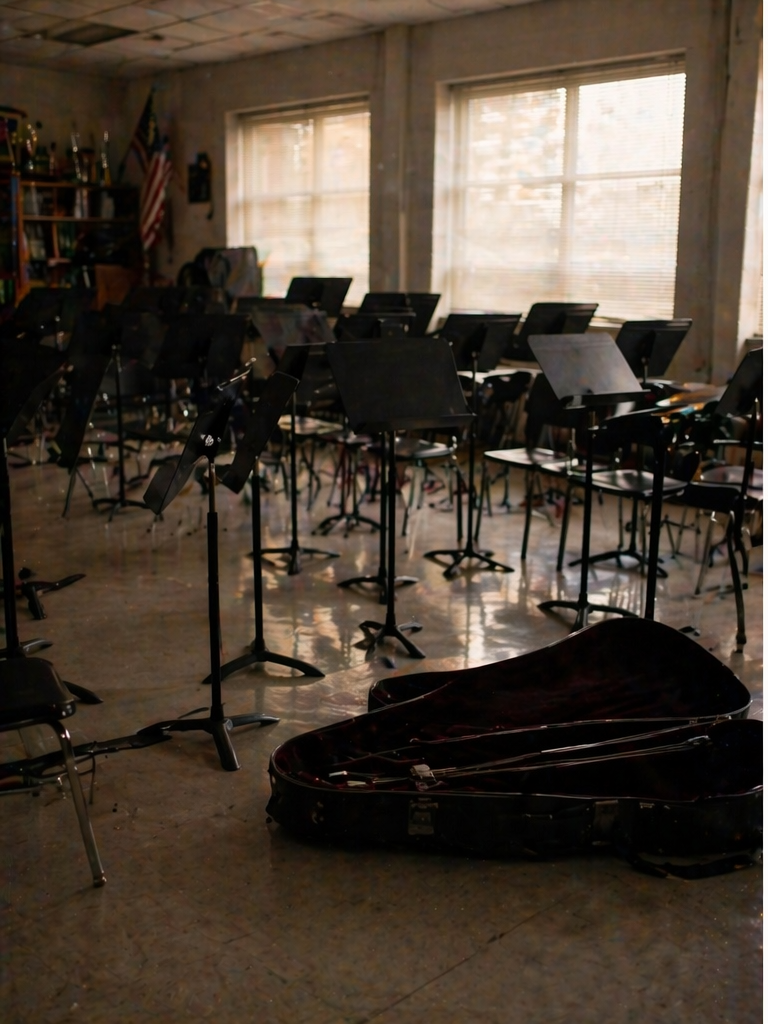
The kids know. That's usually how it goes — the kids find out first, they tell their parents at dinner, and the parents start making calls that nobody answers. That's where Winston-Salem/Forsyth County Schools is right now.
Multiple parents in the district contacted Spotlight Dispatch in recent days to report that their children had come home saying orchestra was being cut. Not scaled back. Cut. The instruments, the chairs, the class period, the program — gone. The accounts are pointing to a specific school: Clemmons Middle School. Students there are describing the same thing — teachers have told them, quietly, that orchestra will not exist next year.
When Spotlight Dispatch asked the district to confirm or deny the cuts, we received no response.
We asked again. Still nothing.
Support This Story
In the course of reporting this story, I spoke with a man whose nephew is a ninth grader at West Forsyth High School. The kid plays orchestra. He came home and told his mother the program was being cut. No letter from the school. No announcement. No meeting. Just a kid at dinner telling his mom what the district would not say out loud.
That conversation is why I started this fundraiser. Winston-Salem/Forsyth County Schools is facing a $46 million budget deficit. It has cut 343 positions. Schools are running out of basic supplies mid-year. More than $75 million in administrative bonuses were paid out in recent years. The paper ran out. The orchestra is being cut. The kids found out before the parents did.
Middle school orchestra is the feeder program. Cut it now and the high school programs die quietly in a few years — no announcement needed, no one to blame. Every dollar raised goes directly toward keeping these programs alive: instruments, instruction, and the pipeline that gives kids in Forsyth County somewhere to go with their talent.
If you have a child in WSFCS, or a public school once handed you an instrument and told you that you could — this one's for you.
Support the Campaign on GoFundMe →This is worth pausing on. Winston-Salem/Forsyth County Schools is facing a $46 million budget deficit. In a district that large, staring down a hole that deep, decisions are being made. Programs are being eliminated. Staff are being cut. Supplies are running out. These are not rumors — the district has publicly acknowledged a $46 million shortfall, confirmed cuts to 343 positions, and presided over schools that parents and teachers describe as running out of basic materials mid-year. Paper. Pencils. The stuff a school needs to be a school.
Clemmons Middle School orchestra students say they were told quietly by teachers that the program is ending. The district has not issued any official communication.
None of that is in dispute. What's in dispute — what the district refuses to either confirm or address — is what's happening to music.
Orchestra is not a luxury program. That's the argument every arts administrator makes and every school board dismisses with a budget spreadsheet, so let's set aside the philosophical debate and look at the practical consequence the district seems to be hoping nobody notices. Middle school orchestra is the feeder program. It is where students learn to play before they get to high school. If you eliminate middle school orchestra this year, you don't just lose this year's students. You lose the pipeline. The high school orchestras run out of incoming players. Within three to five years, you don't have high school orchestras anymore either. You don't need to cut them — they die on their own from the bottom up.
It's a quiet way to eliminate a program. Quiet enough that the district apparently feels comfortable not announcing it.
The financial backdrop is not complicated, though the district appears to be hoping it stays complicated enough that no one does the arithmetic. WSFCS is facing a $46 million deficit. The district is cutting 343 positions. The Forsyth County Schools Foundation raised $9 million in its 'All In For Our Schools' campaign — a number that looks impressive until you hold it next to the deficit. Meanwhile, reporting by the Winston-Salem Journal and others has documented that the district paid out more than $75 million in administrative bonuses over recent years. The bonuses were paid. The paper ran out. The orchestra teachers are apparently being told to wind down.
A district spokesperson did not respond to requests for comment.
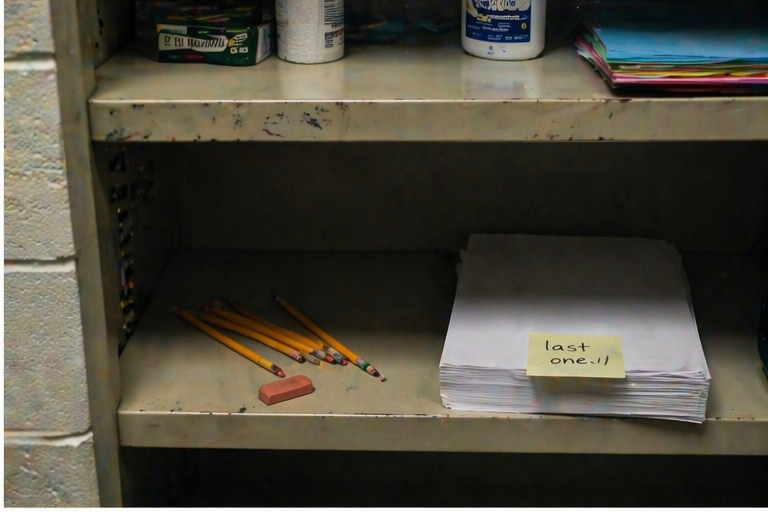
Supply shortages have been visible for months — a problem the district acknowledged. What's happening to music programs is a problem they haven't acknowledged at all.
To be precise about what we know and what we don't: Spotlight Dispatch has spoken with parents whose children attend Clemmons Middle School. The accounts are consistent. Students are describing conversations with teachers — not formal announcements, not letters home, not anything that creates a paper trail — in which they've been told the program is ending. No parent we spoke with has received official communication from the district. No letter. No email. No meeting. Just their kid at dinner, saying the teacher told them today.
That's a choice. When an institution cuts something it doesn't want to defend publicly, it cuts quietly. It lets the information travel through children, hoping the parents will be too busy or too confused or too unsure whether they heard right to push back before the decision is locked in. It's not unique to school districts. It's not even unusual. It is, however, something worth calling what it is.
The students who are currently in middle school orchestra — learning an instrument, preparing to continue in high school — are being told their program is ending by the same adults who are supposed to be advocating for them. The high school students who are currently in orchestra will age out. There will be no one coming up behind them. And the district will be able to say, a few years from now, that the high school orchestras just kind of faded away. Lack of interest. Changing times. Nothing to do with any decision anyone made.
We will be watching for that statement.
A spokesperson for WSFCS did not respond to requests for comment.
What They Left Out
There is a version of this story where the district responds and says the students misunderstood their teachers, or the cuts are not as sweeping as reported, or alternative funding has been secured, or the program is being restructured rather than eliminated. That version of the story would require the district to say something. They haven't.
There is also a version where a school board member, a superintendent, a communications director — someone with authority and a title — puts their name on a statement explaining what is actually happening to music education in Forsyth County. That version also requires someone to speak. The silence suggests that speaking is the part they'd like to avoid.
The $46 million deficit is real. The 343 position cuts are real. The supply shortages are real enough that teachers have been documented spending their own money on classroom basics. The $75 million in administrative bonuses is real — reported, sourced, not disputed by the district. All of it is real.
The orchestra cuts are real too. Ask the kids.
If you are a parent, student, teacher, or staff member at Clemmons Middle School or anywhere in WSFCS and have information about what is happening to music programs, contact Spotlight Dispatch. We are not done reporting this story. And if you want to make your voice heard directly — the WSFCS Board of Education holds public meetings and takes public comment. The Superintendent's office can be reached through the district's main line at (336) 727-2816. The school board chair and individual board members are publicly listed at wsfcs.k12.nc.us. Use them.
What They Left Out
More wild facts from today in history →
The stories history recorded. The parts they didn't emphasize.
Spotlight Dispatch
Some of what you just read is real. Some of it is satire. We leave that as an exercise for the reader.